What Dumbbell Weight Should I Use?

The right dumbbell weight should allow you to complete 8 to 15 controlled repetitions. The final few repetitions should feel difficult, but your posture, range of motion and technique should remain consistent.
If you cannot complete eight clean repetitions, reduce the weight. If you can complete 15 repetitions comfortably and could continue for several more, increase it.
You will normally need different weights for different exercises. A suitable load for lateral raises may be too light for rows, presses, squats or Romanian deadlifts.
This is why the available weight levels matter when choosing Stealth adjustable dumbbells for a home gym.
Stealth Adjustable Dumbbell Weight Ranges
The table below compares the available weight levels across the Stealth adjustable dumbbells range.
Model |
Weight range per dumbbell |
Increment |
Upgradeable |
Best suited to |
|---|---|---|---|---|
2 to 40 kg |
2 kg |
No |
Beginners who need a lower starting weight and the full 40 kg capacity |
|
4 to 23.5 kg |
1.5 kg |
Capacity selected when purchasing |
Accessory work, upper-body training and lighter full-body sessions |
|
4 to 32.5 kg |
1.5 kg |
Capacity selected when purchasing |
Intermediate strength training and heavier compound exercises |
|
4 to 41.5 kg |
1.5 kg |
Capacity selected when purchasing |
Heavy home strength training and maximum long-term capacity |
|
4 to 23.5 kg |
1.5 kg |
Upgrades to 32.5 kg |
Beginners who want to expand the system later |
|
4 to 32.5 kg |
1.5 kg |
Upgrades to 41.5 kg |
Developing lifters who need more room to progress |
|
4 to 41.5 kg |
1.5 kg |
Full capacity |
Experienced lifters and demanding compound movements |
The main decision is not simply how much you can lift today. It is how much resistance you need across your whole workout and how much room you want for future progression.
How to Find the Right Dumbbell Weight
Use the following test for each exercise.
1. Begin with a manageable weight
Choose a weight you expect to control comfortably. Starting lighter makes it easier to learn the movement and identify problems with balance, posture or technique.
2. Perform 10 controlled repetitions
Keep every repetition consistent. Do not shorten the movement, speed up or use momentum as the set becomes harder.
3. Assess the remaining effort
After the tenth repetition, estimate how many more clean repetitions you could complete.
Result after 10 repetitions |
What it means |
What to do |
|---|---|---|
Five or more repetitions remained |
The weight is probably too light |
Increase by the smallest available increment |
Two to four repetitions remained |
The weight is suitable for a working set |
Keep the weight and monitor your technique |
One repetition remained |
The weight is challenging |
Use it only if every repetition stays controlled |
Technique changed before repetition 10 |
The weight is too heavy |
Reduce the load |
Sharp or unusual pain occurred |
Stop the exercise |
Do not continue until the cause is understood |
University Hospitals Coventry and Warwickshire advises that a strengthening load should allow roughly 10 to 15 repetitions. Its guidance also states that being unable to complete more than eight repetitions can indicate that the weight is too heavy. Read the UHCW physiotherapy guidance.
Suggested Starting Weights by Exercise
The figures below are conservative test ranges for adults who are new to dumbbell training. They are starting points, not fixed rules.
All weights are per dumbbell unless stated otherwise.
Exercise |
Starting test range |
Target repetitions |
What good control looks like |
|---|---|---|---|
Lateral raise |
1 to 3 kg |
10 to 15 |
No leaning, swinging or shrugging |
Front raise |
1 to 3 kg |
10 to 15 |
Torso remains still |
Biceps curl |
2 to 5 kg |
8 to 15 |
Elbows remain close to the body |
Triceps extension |
2 to 5 kg |
8 to 15 |
Weight is lowered under control |
Shoulder press |
2 to 6 kg |
8 to 12 |
No excessive arching of the back |
Chest press |
3 to 8 kg |
8 to 12 |
Controlled lowering and pressing |
One-arm row |
4 to 10 kg |
8 to 15 |
Torso remains stable |
Split squat |
2 to 8 kg |
8 to 12 per leg |
Balanced and controlled descent |
Romanian deadlift |
4 to 12 kg |
8 to 15 |
Neutral back and controlled hip movement |
Goblet squat |
4 to 12 kg total |
8 to 15 |
Stable posture and consistent depth |
Some beginners will need to start below these ranges. People with previous strength training experience may need to start above them.
Current UK beginner guidance recommends choosing a load according to control and set performance rather than relying on the number alone. Boots beginner dumbbell weight guide.
Why One Weight Is Not Enough
Different exercises place different demands on the body.
A lateral raise uses relatively small muscles while holding the dumbbell away from the body. Even a small weight increase can feel substantial.
A one-arm row uses the larger muscles of the back. Most people can row considerably more than they can raise to the side.
Lower-body exercises can require more resistance again. Your glutes, hamstrings and quadriceps can normally handle heavier loads than the muscles used during curls or raises.
A single fixed weight may work for one exercise but be unsuitable for the rest of your workout. Stealth adjustable dumbbells allow the resistance to change between movements without requiring a full rack of fixed weights.
Stealth Core Edition: 2 to 40 kg
The Stealth Core Edition adjusts from 2 to 40 kg per dumbbell in 2 kg increments.
The 2 kg starting point is useful for beginners and for exercises where 4 kg may initially be too demanding, including:
- Lateral raises
- Front raises
- Smaller shoulder exercises
- Controlled technique practice
- Light arm exercises
- Warm-up sets
The 40 kg maximum provides room for heavier exercises as your strength develops, including:
- Chest presses
- One-arm rows
- Romanian deadlifts
- Lunges
- Split squats
- Goblet squats
The Stealth Core Edition provides one complete 2 to 40 kg range. It is not designed to be upgraded from a lower maximum capacity.
This makes the Stealth Core Edition a clear choice for someone who wants the lowest available starting weight and access to 40 kg from the beginning.
The 2 kg increments are straightforward, but the jump can feel significant during smaller exercises. Moving from 2 to 4 kg doubles the load. Beginners may need to add repetitions and improve control before moving to the next setting.
Stealth Black Edition: Three Weight Capacities
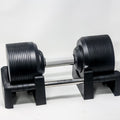
The Stealth Black Edition starts at 4 kg and is available in three maximum weight versions:
- 4 to 23.5 kg per dumbbell
- 4 to 32.5 kg per dumbbell
- 4 to 41.5 kg per dumbbell
Each Stealth Black Edition uses 1.5 kg increments.
These smaller increases can make progression more manageable during curls, shoulder presses, chest presses and other exercises where a larger jump may affect technique.
Stealth Black Edition 23.5 kg
The Stealth Black Edition 23.5 kg provides a compact entry into the Black range.
It can support upper-body exercises, accessory movements and introductory full-body training. It may also provide enough resistance for people who do not plan to perform heavy rows or lower-body exercises.
The main limitation is the maximum weight. As strength improves, 23.5 kg may become restrictive for:
- One-arm rows
- Romanian deadlifts
- Goblet squats
- Split squats
- Heavy chest presses
Choose the Stealth Black Edition 23.5 kg when its maximum genuinely covers your intended training.
Stealth Black Edition 32.5 kg
The Stealth Black Edition 32.5 kg provides more capacity for intermediate strength training.
It can accommodate heavier rows, presses and lower-body movements while retaining the 4 kg minimum and 1.5 kg increments.
For many home lifters, the Stealth Black Edition 32.5 kg offers a useful balance between current requirements and future progression.
Stealth Black Edition 41.5 kg
The Stealth Black Edition 41.5 kg provides the full Black weight range.
It is designed for people who already train with heavier dumbbells or want greater long-term capacity for compound exercises.
The additional weight is particularly relevant for:
- Dumbbell bench presses
- One-arm rows
- Romanian deadlifts
- Walking lunges
- Split squats
- Heavy goblet squats
The Stealth Black Edition 41.5 kg gives you more room to progress, but the extra capacity only adds value if your programme will use it.
Before choosing extra capacity, consider whether adjustable dumbbells are worth the money for your training, including the space, handling and long-term value trade-offs.
Stealth Chrome Gen 6: Start at 23.5 kg and Upgrade Later
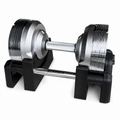
The Stealth Chrome Gen 6 provides a personalisable staged purchasing route. From Gen 6 onwards, the 4kg to 23.5kg system is the starting Chrome product. Official upgrade packages extend it to 32.5kg and then 41.5kg, so those capacities are not separate standalone Chrome dumbbells. Gen 6 also includes adjustable dumbbell bases.
Begin with the 23.5 kg system, then add the official 32.5 kg and 41.5 kg upgrade packages as your strength and training requirements develop.
The Stealth Chrome Gen 6 upgrade path is:
- Start with 4 to 23.5 kg
- Upgrade from 23.5 to 32.5 kg
- Upgrade from 32.5 to 41.5 kg
This makes the Stealth Chrome Gen 6 particularly useful for beginners and developing lifters who want premium Stealth adjustable dumbbells without purchasing the full weight capacity immediately.
Stage One: Chrome Gen 6 23.5 kg
The Stealth Chrome Gen 6 23.5 kg provides the first stage of the system.
It offers enough resistance for many curls, raises, presses and introductory full-body exercises. The 1.5 kg increments provide controlled progression between settings.
This capacity may suit you if:
- You are beginning structured dumbbell training
- Most of your exercises use less than 20 kg per dumbbell
- You want a lower initial purchase
- You expect your strength to increase gradually
- You want to expand the system rather than replace it
The 4 kg minimum may still be too heavy for some beginners performing lateral raises or smaller shoulder exercises. A lighter fixed pair can complement the Stealth Chrome Gen 6 23.5 kg when needed.
Stage Two: Upgrade Chrome Gen 6 to 32.5 kg
The first Stealth Chrome Gen 6 upgrade increases the maximum from 23.5 to 32.5 kg per dumbbell.
This becomes useful when the original range no longer provides enough resistance for your strongest exercises.
You may be ready for the 32.5 kg upgrade if:
- You regularly reach 23.5 kg for rows or presses
- You can complete the top of your repetition range comfortably
- Lower-body exercises are no longer sufficiently challenging
- You have started adding excessive repetitions to compensate for the weight limit
- Your programme now includes heavier compound movements
Upgrading the Stealth Chrome Gen 6 means you keep the original system and extend its capacity. You do not need to sell the 23.5 kg pair and purchase completely different dumbbells.
Stage Three: Upgrade Chrome Gen 6 to 41.5 kg
The second Stealth Chrome Gen 6 upgrade increases the maximum from 32.5 to 41.5 kg per dumbbell.
This provides the complete weight range and the greatest capacity for heavy home strength training.
The 41.5 kg maximum is most relevant for stronger movements such as:
- One-arm rows
- Dumbbell bench presses
- Romanian deadlifts
- Walking lunges
- Split squats
- Heavy goblet squats
You may be ready for the full Stealth Chrome Gen 6 upgrade if:
- You regularly use the 32.5 kg maximum
- Your programme requires loads above 32.5 kg
- You want more resistance for lower-body training
- You are building a long-term home gym
- You want to avoid adding separate heavy fixed dumbbells
Why the Chrome Gen 6 Upgrade Path Matters
Strength does not develop at the same rate for everyone.
A beginner may spend considerable time within the 4 to 23.5 kg range. Buying the full 41.5 kg capacity immediately provides more room, but much of that capacity may remain unused during the early stages of training.
The Stealth Chrome Gen 6 allows the equipment to develop alongside the user.
Training stage |
Recommended Chrome Gen 6 stage |
Reason |
|---|---|---|
Beginning structured dumbbell training |
Covers lighter exercises and provides room for initial progression |
|
Developing intermediate strength |
Adds capacity for heavier presses, rows and leg exercises |
|
Regular heavy home training |
Provides the full range for demanding compound movements |
This staged approach removes the need to predict exactly how strong you will become.
Start with the Stealth Chrome Gen 6 23.5 kg if it covers your current training. Upgrade to the Stealth Chrome Gen 6 32.5 kg when 23.5 kg becomes limiting. Move to the Stealth Chrome Gen 6 41.5 kg when your strongest exercises require the additional capacity.
Use official compatible upgrade components and follow the supplied installation instructions.
Which Stealth Adjustable Dumbbells Should You Choose?
Choose the Stealth Core Edition if you need the lowest starting weight.
Its 2 kg minimum is useful for beginners, smaller upper-body exercises and anyone who finds 4 kg too heavy. It also includes the complete 40 kg capacity from the outset.
Choose the Stealth Black Edition if you want 1.5 kg increments and a choice of maximum capacities.
The Stealth Black Edition is available with a 23.5, 32.5 or 41.5 kg maximum.
Choose the Stealth Chrome Gen 6 if you want a clear staged upgrade route.
The Stealth Chrome Gen 6 allows you to begin at 23.5 kg, upgrade to 32.5 kg and eventually reach 41.5 kg without replacing the original system.
Your priority |
Most suitable option |
|---|---|
Lowest starting weight |
|
Complete 2 to 40 kg range |
|
Smaller 1.5 kg increments |
|
Choice of three maximum capacities |
|
Staged upgrade path |
|
A fixed 41.5 kg capacity from the outset |
You can also compare the complete Stealth adjustable dumbbell range.
When Should You Increase the Weight?
Increase the dumbbell weight when you can complete the top of your planned repetition range with consistent technique across repeated sessions.
If your target is 8 to 12 repetitions:
- Select a weight you can lift for eight controlled repetitions.
- Keep the weight while gradually adding repetitions.
- Reach 12 repetitions with consistent technique.
- Repeat that performance across all planned sets.
- Increase the weight by the smallest available increment.
- Return to the lower end of the repetition range.
Do not increase the weight because of one unusually strong set. Look for repeatable performance.
Signs That the Weight Is Too Heavy
Reduce the load if:
- You use momentum to begin the repetition
- Your range of motion becomes shorter
- Your back arches or rounds
- You cannot lower the dumbbell under control
- Your posture changes during the set
- One side performs more of the movement
- You cannot complete at least eight repetitions
- You experience pain rather than muscular effort
The NHS recommends building up slowly and increasing repetitions gradually. Its home strength guidance also emphasises slow, controlled movement. Read the NHS strength exercise guidance.
Frequently Asked Questions
Is 23.5 kg enough for adjustable dumbbells?
A 23.5 kg maximum can support a wide range of curls, raises, presses and full-body exercises. Stronger users may eventually need more resistance for rows, Romanian deadlifts and lower-body movements.
The Stealth Chrome Gen 6 allows you to start at 23.5 kg and upgrade when that maximum becomes restrictive.
Should I buy 32.5 or 41.5 kg dumbbells?
Choose 32.5 kg if it covers your current strongest exercises and leaves room for progression. Choose 41.5 kg if you already train close to 32.5 kg or expect to need more resistance for heavy presses, rows and lower-body work.
Both capacities are available in the Stealth Black Edition. The Stealth Chrome Gen 6 allows you to begin at a lower capacity and upgrade later.
What is the lightest Stealth adjustable dumbbell?
The Stealth Core Edition starts at 2 kg per dumbbell.
The Stealth Black Edition and Stealth Chrome Gen 6 start at 4 kg.
Can Chrome Gen 6 dumbbells be upgraded?
Yes. The Stealth Chrome Gen 6 can be upgraded from 23.5 to 32.5 kg, then from 32.5 to 41.5 kg.
Is the Core Edition upgradeable?
No. The Stealth Core Edition is supplied as a complete 2 to 40 kg system.
Is 4 kg too heavy for a beginner?
It depends on the exercise. A beginner may manage 4 kg for rows, presses or lower-body movements but find it too heavy for lateral raises and smaller shoulder exercises.
If you need a lower minimum, the Stealth Core Edition begins at 2 kg.
Final Answer
Choose a dumbbell weight that allows 8 to 15 controlled repetitions, with the final few feeling difficult.
For the lowest starting weight, the Stealth Core Edition covers 2 to 40 kg per dumbbell in 2 kg increments.
For smaller 1.5 kg progression steps, the Stealth Black Edition is available in 4 to 23.5 kg, 4 to 32.5 kg and 4 to 41.5 kg versions.
For the most flexible long-term route, the Stealth Chrome Gen 6 allows you to begin with 23.5 kg, upgrade to 32.5 kg and then extend the same system to 41.5 kg.
The correct choice is not necessarily the heaviest dumbbell available. Choose the range that covers your current exercises, provides manageable increments and leaves enough capacity for future training.
Related products
 SALE
SALE
Stealth Equipment Chrome 32.5kg to 41.5kg Upgrade Package (Gen 6)
 SALE
SALE
Stealth Adjustable Dumbbells Black Edition (Pair)
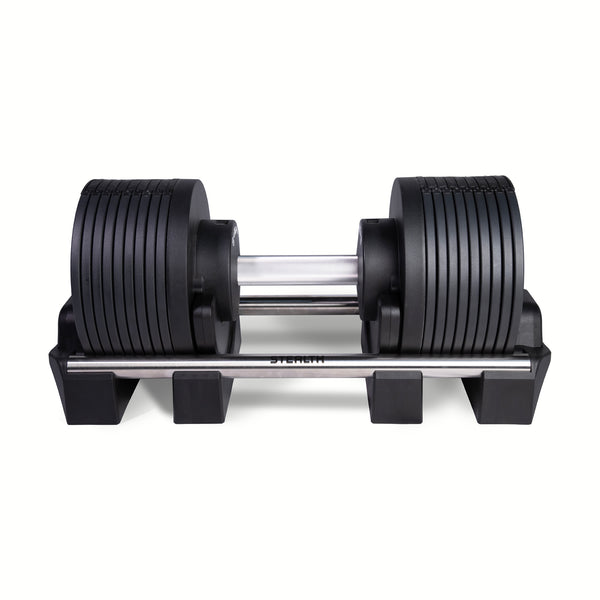 SALE
SALE
Stealth Adjustable Dumbbells Core Edition 40kg (Pair)
SALE
Stealth Equipment Chrome 23.5kg to 32.5kg Upgrade Package (Gen 6)
On Google
Make us a preferred source
Add Assassin Goods as a preferred source on Google and our training intel and gear guides show up more often in your results. One tap, free, and you can undo it any time.