How to Build a Bigger Back ONLY Using Dumbbells

How to Build a Bigger Back With Adjustable Dumbbells
You can build a bigger back using only adjustable dumbbells. The key is to train the back through several movement patterns, work close enough to muscular fatigue and gradually increase the difficulty of your training.
A complete dumbbell back workout should include horizontal rows, pullovers, reverse flies, shrugs and hip-hinge movements. Together, these exercises can train the lats, trapezius, rhomboids, rear shoulders and spinal erectors without requiring a commercial gym.
This guide gives you two back workouts to alternate each week, along with the technique, progression and recovery guidance needed to make them productive.
Can You Build a Big Back Using Only Dumbbells?
Yes. Dumbbells can provide enough resistance to build back strength and muscle when you use suitable exercises and progressively increase the training demand.
The back is not one muscle, however. Relying entirely on standard bent-over rows can leave important functions undertrained.
A balanced dumbbell back programme should include:
- Rows that bring the upper arm towards the torso
- Pullovers that train shoulder extension
- Reverse flies and rear-delt rows for the upper back
- Shrugs and loaded holds for the trapezius
- Hip hinges for the spinal erectors and posterior chain
Exercise selection is only part of the process. You must also perform enough challenging work, control the repetitions and progressively improve your performance.
Which Back Muscles Can You Train With Adjustable Dumbbells?
Back area |
Main function |
Useful dumbbell exercises |
|---|---|---|
Latissimus dorsi |
Pulls the upper arm towards and behind the body |
One-arm rows, bent-over rows and pullovers |
Rhomboids |
Draw the shoulder blades together |
Rows, rear-delt rows and reverse flies |
Trapezius |
Controls the shoulder blades and supports the upper back |
Shrugs, rows, reverse flies and loaded holds |
Rear deltoids |
Moves the upper arm backwards |
Reverse flies and rear-delt rows |
Spinal erectors |
Stabilises and extends the spine |
Romanian deadlifts and unsupported rows |
Teres major and surrounding upper-back muscles |
Assists shoulder extension and pulling |
Rows and pullovers |
No single exercise trains every area equally. Combining several movement patterns produces more complete back training than adding endless sets of the same row.
Dumbbell-Only Back Workout at a Glance
Alternate Workout A and Workout B, leaving enough recovery time between them. For most people, training the back twice per week is a practical starting point.
Workout A: Back Strength and Thickness
Exercise |
Sets |
Repetitions |
Main emphasis |
|---|---|---|---|
One-arm dumbbell row |
3 |
8–12 per side |
Lats and mid-back |
Dumbbell Romanian deadlift |
3 |
8–12 |
Spinal erectors and posterior chain |
Bent-over reverse fly |
2–3 |
12–20 |
Upper back and rear shoulders |
Dumbbell shrug |
2–3 |
10–15 |
Upper trapezius |
Workout B: Lats and Upper Back
Exercise |
Sets |
Repetitions |
Main emphasis |
|---|---|---|---|
Two-arm bent-over dumbbell row |
3 |
8–12 |
Lats, rhomboids and trapezius |
Dumbbell floor pullover |
3 |
10–15 |
Lats and shoulder extension |
Dumbbell rear-delt row |
2–3 |
10–15 |
Upper back and rear shoulders |
Farmer’s hold |
2–3 |
30–45 seconds |
Trapezius, grip and trunk stability |
These workouts can be performed as dedicated back sessions or incorporated into a wider upper-body or full-body programme.
The Best Adjustable Dumbbell Exercises for Building Your Back
One-Arm Dumbbell Row
The one-arm row allows you to train each side independently and support your body with the free hand. This makes it easier to focus on the back without lower-back fatigue ending the set first.
To perform it:
- Support one hand on a stable bench or solid surface.
- Place your feet securely and keep your torso controlled.
- Allow the working arm to extend towards the floor.
- Pull the dumbbell towards your hip.
- Pause briefly without twisting your torso.
- Lower the weight under control.
Think about moving your elbow towards your hip rather than simply lifting the dumbbell upwards. Avoid turning the movement into a full-body rotation.
Two-Arm Bent-Over Dumbbell Row
This variation trains both sides simultaneously and requires more work from the spinal erectors to hold the torso in position.
To perform it:
- Hold one dumbbell in each hand.
- Push your hips backwards and soften your knees.
- Keep your spine neutral and torso stable.
- Pull both dumbbells towards your lower ribs or waist.
- Bring the shoulder blades back without aggressively shrugging.
- Lower the dumbbells under control.
If maintaining the bent-over position becomes the limiting factor, use one-arm supported rows instead.
Dumbbell Romanian Deadlift
While the Romanian deadlift is primarily a hip-hinge exercise, it also trains the spinal erectors isometrically as they stabilise the torso.
To perform it:
- Stand with a dumbbell in each hand.
- Keep your knees slightly bent.
- Push your hips backwards while maintaining a neutral spine.
- Keep the dumbbells close to your legs.
- Descend until you feel a strong stretch through the hamstrings.
- Drive the hips forwards to stand.
Do not chase additional depth by rounding your back. The useful range ends when you can no longer maintain your position.
Bent-Over Reverse Fly
Reverse flies use lighter weights than rows but provide useful work for the rear shoulders, rhomboids and middle trapezius.
To perform it:
- Hinge forwards with a stable torso.
- Hold the dumbbells beneath your shoulders.
- Keep a soft bend in your elbows.
- Raise your arms out to the sides.
- Stop before the movement turns into a shrug.
- Lower the weights slowly.
Use a manageable load. Heaving heavier dumbbells upwards usually transfers work away from the muscles you are trying to train.
Dumbbell Pullover
The pullover trains shoulder extension and provides a useful dumbbell-based alternative to another row.
You can perform it on the floor or on a stable bench:
- Hold one dumbbell securely above your chest.
- Keep a slight bend in your elbows.
- Lower the dumbbell behind your head under control.
- Stop at a comfortable range.
- Pull the dumbbell back above your chest.
Keep your ribs controlled rather than excessively arching your lower back. People with shoulder problems may need a shorter range or a different exercise.
Dumbbell Rear-Delt Row
A rear-delt row uses a wider elbow position than a lat-focused row. This shifts more emphasis towards the upper back and rear shoulders.
Pull the dumbbells towards the upper ribs with your elbows travelling outwards. Use less weight than you would for a standard row and avoid shrugging the shoulders towards your ears.
Dumbbell Shrug
Shrugs directly load the upper trapezius.
Hold the dumbbells by your sides and raise your shoulders upwards. Pause briefly, then lower them under control. Keep your head neutral and avoid rolling the shoulders in circles.
Farmer’s Hold
A farmer’s hold is simple but effective for the trapezius, grip and trunk.
Stand upright while holding heavy dumbbells at your sides. Keep your ribs stacked over your pelvis and resist leaning towards either side. If you have enough clear space, you can turn the hold into a farmer’s walk.
How Heavy Should Your Adjustable Dumbbells Be?
The right weight depends on the exercise.
Rows and Romanian deadlifts generally allow heavier loads than reverse flies and pullovers. This is one reason an adjustable system works well for back training. You can change the resistance between exercises without storing several fixed pairs.
Choose a weight that allows you to:
- Complete the target repetition range with controlled technique
- Use the intended muscles rather than relying on momentum
- Maintain roughly one to three repetitions in reserve
- Progress over time without sacrificing position
If you are unsure where to begin, use the complete dumbbell weight guide to estimate a sensible starting point.
How to Progress Your Dumbbell Back Workout
Muscle growth requires more than repeating the same workout indefinitely. The training demand must increase as your body adapts.
A straightforward method is double progression:
Current performance |
What to do next |
|---|---|
Below the target range |
Keep the weight and improve your repetitions |
Inside the target range |
Continue until every set reaches the upper target |
Top of the range with controlled form |
Increase the dumbbell weight |
Technique breaks down after increasing weight |
Reduce the repetitions and rebuild gradually |
Maximum weight reached |
Add a set, slow the lowering phase or use a harder variation |
For example, suppose you perform three sets of one-arm rows with a target of 8–12 repetitions:
- Session one: 10, 9 and 8 repetitions
- Session two: 10, 10 and 9 repetitions
- Session three: 12, 11 and 10 repetitions
- Later session: 12, 12 and 12 repetitions
Once you complete all three sets at 12 controlled repetitions, increase the weight and return towards the lower end of the range.
Research comparing resistance-training approaches consistently supports progressive, multiple-set training for muscle development. It also indicates that every set does not need to reach complete muscular failure. Training close enough to failure to make the set challenging can be productive without forcing every repetition until movement stops. See the relevant resistance-training prescription review and proximity-to-failure meta-analysis.
How Much Weekly Back Training Do You Need?
There is no exact number that suits every person. Training experience, exercise selection, recovery and effort all affect how much work you can use productively.
A reasonable starting point is approximately 8–12 challenging back sets per week, spread across two sessions. Increase the amount only when your recovery and performance justify it.
The two workouts in this guide provide enough work for many beginner and intermediate trainees. More experienced lifters may add sets gradually, but additional volume is only useful if the quality of the work remains high.
The latest American College of Sports Medicine position stand reports that higher weekly resistance-training volume can support hypertrophy, while emphasising that consistent resistance training matters more than unnecessary complexity.
Follow the Workout in the Stealth Training System App
A written workout gives you the structure. Recording each session shows whether that structure is producing progress.
The Stealth Training System app allows you to view your session and log weights, repetitions, effort and workout scores as you train. It also includes personal bests, progress trends, a training heatmap and built-in workout timers.
The app works offline in the gym and synchronises when you regain a connection. It is included with an active Assassin Goods training plan.
You can explore the app, structured programmes and one-off downloadable guides through the Assassin Goods Digital Hub.
Common Dumbbell Back-Training Mistakes
Only Performing Rows
Rows are important, but repeating similar row variations does not automatically create a complete programme.
Include a hip hinge, an upper-back movement and a pullover or other shoulder-extension exercise alongside your main rows.
Using Too Much Momentum
If every repetition requires a sharp torso rotation or sudden hip movement, the selected weight may be too heavy for the intended exercise.
A small amount of natural movement is not automatically a problem. The issue is whether momentum replaces the work your back should be performing.
Pulling Every Row to the Same Position
Elbow path changes the emphasis of a row.
Pulling towards the hip with the elbow closer to the body generally places more emphasis on the lats. Pulling towards the upper ribs with the elbow further out places more emphasis on the upper back and rear shoulders.
Ignoring the Lowering Phase
Dropping the dumbbell rapidly removes control from part of the repetition. Lower the weight deliberately while maintaining your torso position.
Training Hard Without Recording Anything
If you do not record your weights and repetitions, it is difficult to know whether you are progressing.
Use a notebook or log each workout through the Stealth Training System app. Your records should help you decide when to add repetitions, increase resistance or hold the current load.
Adding Weight Before Technique Is Stable
A heavier dumbbell is only useful if you can control it. Progress should not require a shorter range, excessive twisting or a loss of spinal position.
Which Adjustable Dumbbells Suit Back Training?
Back exercises can require substantially different loads. A reverse fly might need a light setting, while rows and Romanian deadlifts may eventually require considerably more weight.
The right capacity depends on your current strength and how long you expect the dumbbells to support your progression.
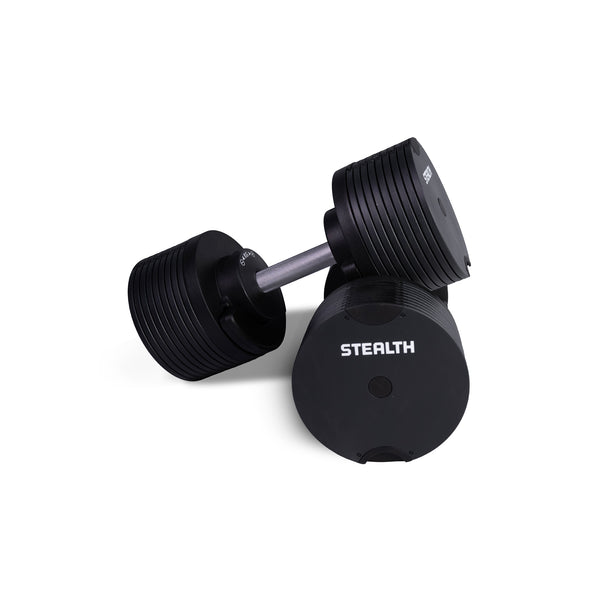
- Stealth Core adjustable dumbbells adjust from 2kg to 40kg per dumbbell and offer a broad range for varied home training.
- Stealth Black Edition adjustable dumbbells are available in separate 4–23.5kg, 4–32.5kg and 4–41.5kg configurations.
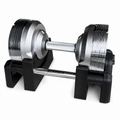
- Stealth Chrome Gen 6 adjustable dumbbells start at 4–23.5kg per dumbbell and use an all-metal plate design. The pair can be expanded to 32.5kg and then 41.5kg using the relevant upgrade packages.
The Stealth adjustable dumbbell collection brings the available systems together. For a fuller comparison of weight ranges, designs and intended uses, read the adjustable dumbbell buyer’s guide.
Can Dumbbells Build Back Width and Thickness?
Dumbbells can contribute to both, although width and thickness are simplified descriptions rather than separate training modes.
Rows performed with the elbow closer to the torso and pullovers can place useful emphasis on the lats. Wider-elbow rows and reverse flies train the upper back, while Romanian deadlifts strengthen the spinal erectors and posterior chain.
A varied programme is more useful than trying to assign every exercise exclusively to either width or thickness.
What Are the Limitations of a Dumbbell-Only Back Workout?
Adjustable dumbbells can cover most major back-training functions, but they do not reproduce every exercise available in a full gym.
The main limitation is vertical pulling. Pull-ups and lat pulldowns train the back through a movement pattern that is difficult to recreate completely using dumbbells.
This does not prevent you from building your back with dumbbells. It simply means that a pull-up bar or resistance band can provide a useful addition if you have the equipment and space.
Grip may also limit heavy rows and holds before your back reaches fatigue. Grip training can be useful, but lifting straps may be appropriate for some experienced lifters when back development is the primary goal.
Safety and Technique
Before beginning:
- Clear enough space to move safely.
- Check that each dumbbell is correctly selected and securely assembled.
- Use a stable bench or support where required.
- Warm up with lighter sets before heavier working sets.
- Keep the dumbbells under control throughout each repetition.
- Stop if you experience sharp or unusual pain.
This article provides general training information, not personalised medical advice. If you have an injury, medical condition or significant uncertainty about exercise, seek appropriate professional guidance.
For more exercise ideas beyond back training, see the complete guide to dumbbell exercises for building strength at home.
Build Your Back With a Structured Plan
You do not need a room full of machines to build a stronger, more muscular back. A suitable pair of Stealth adjustable dumbbells, consistent technique and planned progression can cover most of your back training at home.
Start with two weekly sessions. Record every working set. Add repetitions while keeping the exercise controlled, then increase the weight when you reach the top of the target range.
If you would prefer a complete programme instead of planning every session yourself, explore the Stealth Training System app and training plans. You can find them alongside downloadable training guides in the Assassin Goods Digital Hub.
Frequently Asked Questions
Can I build my back with one pair of adjustable dumbbells?
Yes. One pair can provide enough resistance for rows, Romanian deadlifts, reverse flies, pullovers, shrugs and loaded holds. The available maximum weight must still be appropriate for your current strength and future progression.
How often should I train my back?
Two weekly sessions are a practical starting point for many people. This distributes the work and gives you repeated opportunities to practise the movements and progress.
Are dumbbell rows enough to build a big back?
Rows can build the lats and upper back, but a more complete programme also includes shoulder extension, upper-back isolation, shrugs or loaded holds and a hip-hinge movement.
Should I train my back to failure?
You do not need to take every set to complete muscular failure. Most working sets should be challenging while remaining controlled. Finishing with approximately one to three good repetitions available is a useful practical target.
Can I perform this workout without a bench?
Yes. Bent-over rows, Romanian deadlifts, reverse flies, shrugs and farmer’s holds require no bench. Pullovers can be performed on the floor, and one-arm rows can use another stable support.
How long does it take to build a bigger back?
There is no universal timeline. Your starting point, training quality, nutrition, sleep, genetics and consistency all matter. Assess progress over months rather than expecting a visible transformation after a few sessions.
Related products


On Google
Make us a preferred source
Add Assassin Goods as a preferred source on Google and our training intel and gear guides show up more often in your results. One tap, free, and you can undo it any time.